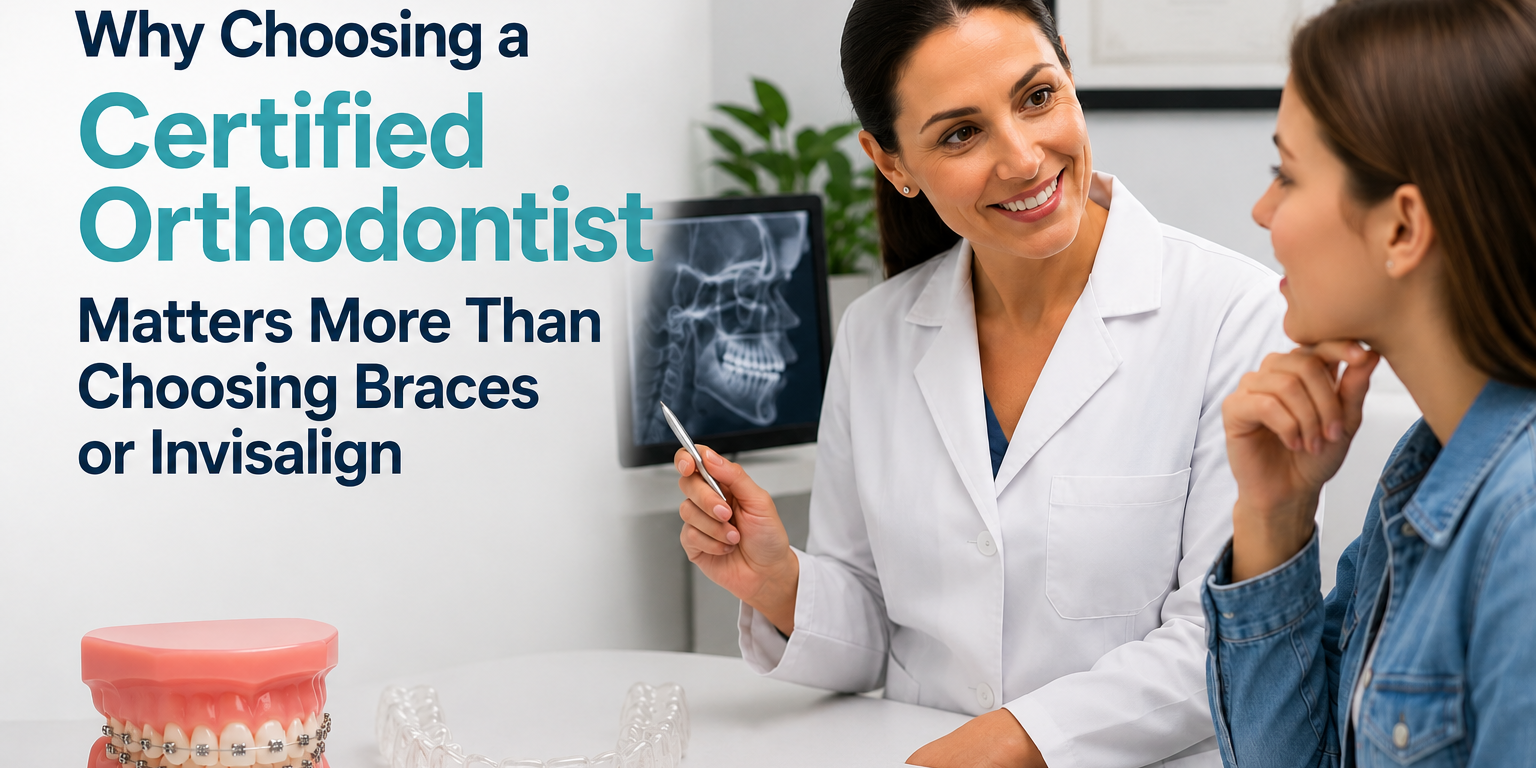
If you’re thinking about straightening your teeth, you’ve probably asked yourself a familiar question: Should I choose Invisalign or braces?
It’s a sensible place to start, but it may not be the most important decision you’ll make.
Whether you choose Invisalign, Pitts 21 braces, Damon braces, or traditional braces, these are simply treatment tools. The quality of your final result depends far more on the expertise of the orthodontist diagnosing your case, creating your treatment plan, and guiding your care from start to finish.
Every smile is unique. Two people with similar-looking teeth may need completely different treatment because of differences in their bite, jaw alignment, facial structure, or long-term oral health goals. That’s why choosing the right orthodontist matters far more than choosing a particular appliance.
At Tropical Orthodontics, every treatment plan is tailored to the individual. Led by Dr. Joel Schacher, who has more than 40 years of orthodontic experience, the practice combines evidence-based care with modern technology to help patients achieve healthy, confident smiles that last.
At a Glance
Before choosing braces or clear aligners, remember these key points:
- A certified orthodontist has years of specialist training beyond dental school.
- Successful treatment depends on accurate diagnosis and personalised planning.
- Long-term oral health and bite function are just as important as straight teeth.
Why Your Choice of Orthodontist Matters
Orthodontic treatment is about much more than creating a beautiful smile.
A healthy bite helps you chew comfortably, keeps your teeth easier to clean, and can reduce uneven tooth wear over time. Creating that balance requires careful planning, not simply straightening the front teeth.
Before recommending treatment, a certified orthodontist evaluates your bite, jaw relationship, facial profile, tooth position, and long-term stability. These findings help determine which approach is most suitable for your individual needs.
This is why two patients with similar-looking smiles may receive completely different treatment recommendations. One person may be an excellent candidate for Invisalign treatment, while another may achieve better long-term results with Pitts 21 braces or another orthodontic system.
If you’re exploring different orthodontic treatment options, understanding the reason behind each recommendation is just as important as understanding the treatment itself.
Certified Orthodontist vs General Dentist
Many people don’t realise that every orthodontist begins their career as a dentist.
After dental school, however, a certified orthodontist completes several additional years of specialist education focused entirely on correcting tooth and jaw alignment problems. This advanced training includes facial growth, bite correction, biomechanics, and long-term treatment planning.
General dentists play a vital role in maintaining oral health through preventive and restorative care. Certified orthodontists, on the other hand, dedicate their careers exclusively to diagnosing and treating orthodontic conditions.
This distinction is recognised by organisations such as the Canadian Association of Orthodontists and the Royal College of Dentists of Canada, which recognise orthodontics as a specialist field.
For patients, the difference means treatment decisions are based on comprehensive specialist assessment rather than simply choosing an appliance.
Orthodontic Treatment Starts Before Braces
Many patients think treatment begins when braces are fitted or the first aligner is worn. In reality, successful orthodontic care starts much earlier with a thorough assessment.
During your consultation, an orthodontist evaluates far more than crooked teeth. They assess your bite, jaw alignment, facial balance, gum health, available space, and, for younger patients, future jaw growth. This information forms the foundation of a personalised treatment plan.
For example, someone with crowded teeth may benefit from non-extraction orthodontics, while another patient with a similar appearance may require a different approach because of their bite or jaw relationship. The treatment follows the diagnosis, not the other way around.
That’s why the expertise of your orthodontist has a much greater influence on your final result than the appliance you choose.
Braces, Invisalign and Pitts 21 Are Tools, Not the Treatment
One of the most common questions patients ask is, “Which is better, Invisalign or braces?”
The truth is, there isn’t a single answer.
Modern orthodontics offers several excellent treatment options, including Invisalign, Pitts 21 braces, Damon braces, ceramic braces, and traditional metal braces. Each has its own advantages, but none is automatically the best choice for every patient.
The right treatment depends on your individual diagnosis, bite, jaw alignment, lifestyle, and long-term goals.
For example, many adults choose Invisalign treatment because of its discreet appearance and flexibility. Others with more complex bite concerns may achieve better results with Pitts 21 braces or another fixed appliance that provides greater control over tooth movement.
Rather than asking, “Which braces are best?”, a better question is, “Which treatment is best for my smile?”
That answer can only come after a comprehensive assessment by a certified orthodontist.
Personalised Treatment Planning Makes the Difference
No two smiles are exactly alike.
Two patients may both have crowded teeth, yet require completely different treatment because of differences in their bite, jaw position, facial profile, or oral health.
That’s why orthodontic treatment should never follow a one-size-fits-all approach.
A personalised treatment plan considers:
- Bite alignment
- Jaw development
- Facial balance
- Gum and bone health
- Treatment stability
- Lifestyle and patient goals
These factors help determine not only how teeth should move, but also when and why they should move.
At Tropical Orthodontics, every treatment recommendation is based on achieving a healthy, functional bite while creating a confident smile. Whenever appropriate, treatment is planned to preserve healthy natural teeth through non-extraction orthodontics, supporting both long-term stability and facial aesthetics.
Modern Technology Supports Better Care
Technology has transformed orthodontics, making treatment more precise and comfortable than ever before.
Digital scans have replaced many traditional impressions, while advanced imaging and treatment planning software help orthodontists visualise tooth movement before treatment begins. These innovations improve communication with patients and support more accurate planning.
Artificial intelligence is also beginning to assist orthodontists by analysing images and monitoring treatment progress.
However, technology is only one part of the process.
Digital tools provide valuable information, but they cannot replace clinical judgement. Every treatment decision still relies on the orthodontist’s experience, understanding of facial growth, bite function, and the biological response of each patient’s teeth.
Technology enhances orthodontic care. It does not replace the expertise behind it.
Meet Dr. Joel Schacher
Behind every successful orthodontic treatment plan is years of education, experience, and clinical judgement.
For more than 40 years, Dr. Joel Schacher has helped children, teens, and adults achieve healthier smiles through personalised orthodontic care.
After graduating from the University of Toronto Faculty of Dentistry, he completed his specialist orthodontic training at the renowned Eastman Dental Center in Rochester, New York. He is also the founder and President of the Ontario Damon Study Club, has taught orthodontics to dental residents, and continues to support advances in the profession through education and collaboration.
His commitment to clinical excellence has earned Tropical Orthodontics the Consumer Choice Award for Business Excellence for ten consecutive years (2017–2026), reflecting the trust of patients and families throughout Mississauga and the Greater Toronto Area.
Rather than recommending the same treatment for everyone, Dr. Schacher believes in creating personalised treatment plans that deliver healthy, stable, and long-lasting results.
Common Myths About Orthodontic Treatment
Myth: Invisalign is always better than braces.
Fact: Both Invisalign and braces can deliver excellent results. The best option depends on your diagnosis and treatment goals.
Myth: Straight teeth mean a healthy bite.
Fact: A beautiful smile is important, but a healthy bite is essential for long-term oral health and function.
Myth: Technology guarantees better treatment.
Fact: Digital technology improves planning and precision, but successful treatment still depends on the knowledge and experience of the orthodontist.
Questions to Ask Before Choosing an Orthodontist
Starting orthodontic treatment is an important decision, and asking the right questions can help you feel confident about the care you receive.
During your consultation, consider asking:
- Are you a certified orthodontist?
- Why are you recommending this treatment for my smile?
- What are the advantages and limitations of my treatment options?
- How will my bite be monitored throughout treatment?
- What happens after my braces or aligners come off?
A good consultation should leave you with a clear understanding of your diagnosis, treatment plan, expected timeline, and how your results will be maintained long after treatment is complete.
Why Long-Term Stability Matters
Orthodontic treatment doesn’t end when your braces are removed or you wear your last aligner.
Teeth naturally have a tendency to shift over time, which is why the retention phase is just as important as active treatment. Wearing retainers as recommended helps maintain your new smile and protects the investment you’ve made in your oral health.
An experienced orthodontist plans for this from the very beginning. Your treatment isn’t simply about straightening teeth, it’s about creating results that remain healthy and stable for years to come.
At Tropical Orthodontics, long-term stability is an essential part of every personalised treatment plan, helping patients enjoy confident smiles well beyond the completion of active treatment.
Choosing the Right Orthodontist Is an Investment in Your Smile
Today’s patients have more orthodontic treatment options than ever before.
Whether you’re considering Invisalign, Pitts 21 braces, Damon braces, or traditional braces, it’s natural to compare appliances and treatment methods. However, the most important decision isn’t choosing the latest technology or the newest type of braces. It’s choosing the orthodontist who will diagnose your needs, design your treatment plan, and guide your progress every step of the way.
A certified orthodontist brings specialist education, clinical experience, and a deep understanding of how teeth, jaws, and facial structures work together. That expertise helps create results that are not only attractive but also functional, healthy, and designed to last.
For families across Mississauga, Brampton, Oakville, Milton, and the Greater Toronto Area, Tropical Orthodontics has built its reputation by combining advanced technology with personalised, evidence-based care. Under the leadership of Dr. Joel Schacher, whose career spans more than four decades, the practice continues to help children, teens, and adults achieve healthier, more confident smiles.
If you’re exploring your orthodontic treatment options, the best place to start isn’t by asking which braces are better. It’s by choosing an orthodontist who takes the time to understand your smile and recommend the treatment that’s right for you.
Frequently Asked Questions
Is a certified orthodontist different from a general dentist?
Yes. A certified orthodontist completes several additional years of specialist postgraduate training focused exclusively on diagnosing and treating tooth and jaw alignment problems.
Is Invisalign better than braces?
Neither option is universally better. The most suitable treatment depends on your individual diagnosis, bite, lifestyle, and treatment goals. A certified orthodontist can recommend the best approach for your specific needs.
Why is treatment planning so important?
Every smile is unique. A personalised treatment plan helps create healthy, stable results while supporting long-term bite function and oral health.
Can adults benefit from orthodontic treatment?
Absolutely. Modern orthodontic treatments, including clear aligners and braces, can successfully treat many adult patients while fitting comfortably into their personal and professional lives.
Why do I need to wear retainers after treatment?
Retainers help keep your teeth in their new position and reduce the risk of them shifting over time. Following your orthodontist’s recommendations is essential for maintaining long-term results.
Final Thoughts
Choosing braces or Invisalign is only one part of your orthodontic journey. The experience, training, and judgement of the orthodontist behind your treatment have a far greater impact on the final outcome.
By choosing a certified orthodontist who takes a personalised, evidence-based approach, you’re investing in more than a straighter smile. You’re investing in healthier teeth, a balanced bite, and results designed to last for years to come.