
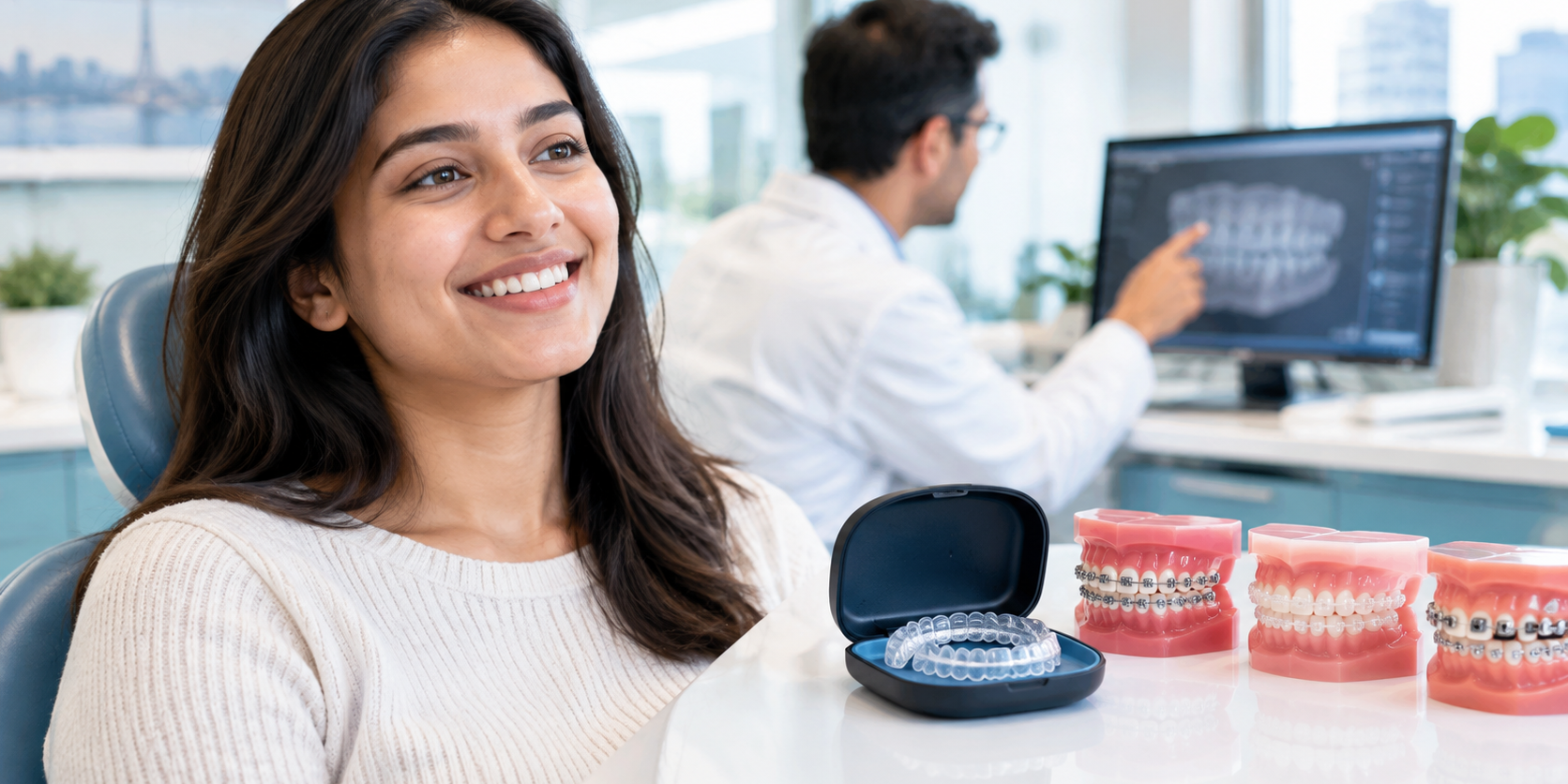
For most people, the decision to look into teeth straightening starts with something they notice in the mirror or a photo. Maybe the lower front teeth have gradually crowded over the years. Maybe a gap has appeared that was not there before. Whatever prompts the thought, it is worth knowing that straightening teeth involves considerably more than improving how a smile looks. How the upper and lower teeth meet, how the bite functions, and how individual teeth are positioned all play a role in what good orthodontic treatment is actually trying to achieve.
If you are exploring your options for teeth straightening in Mississauga, this article walks through the main treatment approaches, what shapes the decision between them, and what to expect when you see an orthodontist for the first time.
What is It Really Like to Get Your Teeth Straighter?
Orthodontic treatment works by applying consistent, controlled pressure to teeth over time to gradually shift them into better positions. That pressure is met by a reaction of the surrounding bone which causes the teeth to move in a predictable and controlled manner.
Treatment planning is more than just getting the teeth into a straight line, it’s the many factors to be considered along with alignment. Factors such as the relationship between the upper and lower jaws, the amount of space available in the arch, the patient’s age and whether growth is still occurring, existing dental work, gum health and what the patient hopes to achieve all contribute to a treatment plan that will be effective for the long term and not just the short term. Orthodontic appliances move teeth by applying pressure, says the Canadian Dental Association. The goal of treatment is to correct the position of teeth and the function of the bite, not to make you look better.
What kind of problems can teeth straightening solve?
Many alignment and bite problems can be corrected with orthodontic treatment. These could be crowded teeth, gaps in teeth, protruding teeth, overbites, underbites and crossbites. Patients come in at different times because teeth shift over time or they have had alignment concerns from childhood.
It’s the nature of the problem and how it affects the whole bite that determines it. An orthodontic assessment can help determine if it’s primarily a tooth position problem, or the relationship between the upper and lower jaws, or a combination of problems.
What Are the Main Teeth Straightening Options?
There is a reasonable range of orthodontic treatment options available today, and understanding what each involves helps when it comes time to discuss them with an orthodontist.
Traditional and Modern Braces
Fixed braces use brackets bonded directly to the teeth, connected by an archwire that applies the force needed to move teeth gradually. The system gives the orthodontist a high degree of control over tooth and bite movement, which is why braces remain one of the most versatile treatment approaches across a wide range of case complexity.
Modern fixed braces look and feel meaningfully different from what most adults remember. Brackets are lower profile, materials have improved, and the overall treatment experience is considerably more comfortable than older designs. Braces are suitable for patients of most ages and can address everything from mild crowding to more complex bite concerns.
Invisalign and Clear Aligners
Invisalign uses a series of custom-made, removable clear aligners designed to progressively move the teeth according to a personalised treatment plan. Patients change aligners according to the schedule provided by their orthodontist.
The appeal for many adults and older teenagers is that the aligners are far less visible than fixed braces and can be removed for eating and oral hygiene. The trade-off is that they need to be worn consistently for the required number of hours each day. Patients who remove them more frequently than recommended will find their treatment is affected. Invisalign treatment suits many mild to moderate cases well, though suitability depends on the specifics of the individual’s teeth and bite, which is why a proper clinical assessment comes before any appliance decision.
Self-Ligating Braces
Self-ligating systems like Damon and Pitts 21 braces use a different bracket mechanism that reduces friction during tooth movement compared to conventional braces. Beyond the mechanical difference, systems like Pitts 21 also place particular emphasis on smile arc development and facial aesthetics alongside tooth alignment, considering how the smile relates to the face as a whole rather than focusing purely on making teeth straight.
These systems are not universally superior to other approaches for every patient. Like all orthodontic appliances, their suitability depends on the individual case and what treatment is trying to achieve.
Which Option Is Right for You?
There is no single answer to this question, and any provider who suggests otherwise is oversimplifying things considerably.
The right treatment depends on the nature and severity of the alignment concern, the bite relationship, the patient’s age, lifestyle, existing dental work, and what the patient is hoping to achieve. Two people with outwardly similar crowding can require quite different approaches once the full clinical picture is assessed. This is exactly why the appliance decision should follow the diagnosis, not precede it.
Can Adults Have Their Teeth Straightened?
Yes, and adult orthodontic treatment has become significantly more common over the past decade. The options available today, including discreet aligner systems and modern low-profile braces, have made treatment considerably more practical for adult life than most people expect going in.
That said, adult cases can involve additional considerations that are less common in teenage patients. Existing crowns, veneers, or implants affect how treatment is planned. Gum health needs to be assessed before treatment begins. Teeth that have shifted over many years may require more involved correction than recent crowding. None of these things necessarily prevent treatment, but they do make thorough assessment more important. The Canadian Association of Orthodontists notes that orthodontic treatment can benefit patients at any age, though the approach needs to be tailored to the individual’s clinical situation.
Can Teeth Be Straightened Without Extractions?
Not automatically, but not necessarily with extractions either. Whether healthy teeth need to be removed to create space depends on the degree of crowding, the bite relationship, the patient’s facial profile, and the long term stability of the planned result.
Today’s orthodontic techniques make non-extraction treatment possible in more cases than ever before, especially with arch development approaches that create space instead of reducing the number of teeth. However, extractions remain the right clinical decision in certain situations, and the choice should always be based on a thorough individual assessment rather than a blanket policy in either direction.
What Happens During an Orthodontic Consultation?
A first consultation with an orthodontist is primarily an assessment appointment. The orthodontist will examine the teeth and bite clinically, and will typically take photographs, digital scans, or X-rays where appropriate to get a complete picture of what is happening beneath the surface as well as what is visible.
From there, the orthodontist will explain what they have found, walk through the treatment options that are appropriate for that specific case, and outline what a personalised treatment plan would involve, including a realistic timeline and what to expect throughout treatment. A good consultation leaves the patient with enough information to make a confident, informed decision without feeling pressured toward any particular outcome.
Choosing an Orthodontist in Mississauga
When looking for an orthodontist in Mississauga, a few things are worth considering beyond location and availability.
An orthodontist is a dental specialist who completes two to three additional years of full-time specialist training after dental school, focused specifically on tooth movement, bite correction, and jaw relationships. That distinction matters when it comes to the quality of diagnosis and the depth of treatment planning involved in your care.
Beyond qualifications, it is worth considering the range of treatment options the practice offers, how thoroughly the orthodontist explains what they have found and why they are recommending a particular approach, and whether you feel the consultation is genuinely tailored to your situation rather than following a standard script. Experience across a wide range of cases also develops clinical judgement that is difficult to acquire any other way.
Frequently Asked Questions
How do I know which teeth straightening option is right for me?
The honest answer is that you need a proper clinical assessment to find out. Factors including crowding severity, bite relationship, age, existing dental work, and treatment goals all shape the recommendation. Choosing based on appearance or price alone often leads to a mismatch between the appliance and what the case actually needs.
Is Invisalign suitable for everyone?
No. Invisalign works well for many mild to moderate cases, particularly in adults and older teenagers. More complex alignment or bite concerns may be better addressed with fixed braces. Suitability is determined through clinical assessment, not self-assessment.
How long does it take to straighten teeth?
Time needed for treatment varies widely depending on complexity of the case. Simple cases are often finished in 12 to 18 months, but more complicated treatment may take longer. Your orthodontist will give you a realistic estimate based upon your individual case.
Does teeth straightening hurt?
Most patients experience some pressure and mild soreness for a day or two after adjustments or when starting a new set of aligners. This settles relatively quickly. Modern systems are considerably more comfortable than older designs.
Do I need a referral to see an orthodontist?
In most cases, no. You can contact an orthodontic practice directly to book a consultation. Some patients are referred by their general dentist, but a referral is not typically required to arrange an initial assessment.