“Is my child old enough for an orthodontist?” is a question many parents ask quietly, often after noticing a crooked tooth, hearing a dentist mention it in passing, or watching a classmate get braces. The reassuring answer is that a first visit tends to come earlier than people expect, and it rarely means braces are about to start.
An early assessment is a chance for an orthodontist to look at how your child’s teeth and jaws are developing and tell you whether anything needs attention now, later or not at all. This guide explains when that visit usually happens, what signs are worth noticing, and what to expect if you book one at Tropical Orthodontics in Mississauga.
At What Age Should a Child First Visit an Orthodontist?
The Canadian Association of Orthodontists recommends that children have an initial orthodontic assessment around age seven. That is usually the stage when the first permanent molars and front teeth have come in, so an orthodontist can start to see how the bite is forming.
At that age, an orthodontist can look at:
- How the upper and lower teeth meet
- Whether there is enough room for the permanent teeth still to come
- How the jaws are growing in relation to each other
- Whether habits such as thumb sucking are affecting the teeth or bite
Age seven is a guideline, not a deadline and not a requirement. Plenty of children are fine without any visit at that age, and older children and teenagers can still be assessed and treated. A first visit does not mean treatment starts. For many children, the outcome is simply “everything looks on track, we’ll check again.”
Wondering whether it’s time for your child’s first visit? Contact our team and we can talk it through.
10 Signs Your Child May Need an Orthodontic Assessment
Some signs are easy to spot at home. None of these proves there is a problem, and an orthodontist needs to look at your child’s individual development to say anything definite. They are reasons to ask.
- Crowded or overlapping teeth. Teeth that look squeezed or are growing in on top of each other.
- Noticeable gaps. Some spacing is normal in young children, but wide or unusual gaps are worth asking about.
- Upper front teeth that stick out. Teeth that protrude noticeably, which can also leave them more exposed to injury.
- An overbite. The upper teeth sit well forward of the lower teeth.
- An underbite. The lower teeth sit in front of the upper teeth.
- A crossbite. Some upper teeth bite inside the lower teeth instead of outside.
- Difficulty biting or chewing. Avoiding certain foods or struggling to bite through them.
- Early or late loss of baby teeth. Baby teeth lost much sooner or later than their friends’ can affect how permanent teeth come in.
- Jaw shifting or an uneven bite. The jaw moves to one side when the mouth closes.
- Teeth that don’t meet properly. Front teeth that don’t touch when biting, or a mouth that doesn’t close comfortably.
If you notice any of these, there is no need to panic. Most are things an orthodontist sees every day, and many simply need to be watched.
Why Is Early Orthodontic Assessment Important?
The value of an early look is information, not a rush to treat. An assessment helps an orthodontist:
- Monitor how the jaws and teeth are developing
- Spot bite problems that are starting to form
- Recognize crowding or alignment issues as they emerge
- Judge whether any early intervention would help
- Plan the best timing if treatment is needed
It helps to separate early identification from early treatment. Identifying a concern early gives you options and time. It does not mean intervention is needed, and it does not promise treatment will be simpler later. Those depend on the individual child.
Does Every Child Need Braces at Age Seven?
No. This is probably the most common worry parents have, so it is worth being clear. An assessment at seven is not the same as starting braces.
After a first visit, children typically fall into one of a few groups:
- No treatment needed at this stage. Development looks on track.
- Monitor over time. The orthodontist watches how the permanent teeth come in and re-checks at intervals.
- Early treatment recommended. Some problems may benefit from being addressed while the child is still growing and still has some baby teeth.
- Treat later. Other issues are best handled once more permanent teeth have come through.
When treatment starts depends entirely on your child’s clinical needs. Is my child too young for braces? Often the honest answer is that braces are not on the table yet, and a conversation is all that is needed.
What Is the Difference Between Phase 1 and Phase 2 Treatment?
You may hear these terms at a consultation.
Phase 1, or early interceptive treatment, takes place while some baby teeth are still present, often between roughly ages seven and ten, though it varies. It is aimed at specific problems, such as certain bite issues or limited space, where acting earlier may help. It is typically shorter and more focused than full treatment.
Monitoring often comes next. Once Phase 1 is complete, or if no early treatment is needed, the orthodontist keeps an eye on development as the remaining permanent teeth come in.
Phase 2 is full treatment, usually with braces, once most or all of the permanent teeth have erupted.
Not every child needs two phases. Many children never need Phase 1 and have a single course of treatment later, and many need none. The answer to “will my child need braces twice?” is usually no, but the orthodontist can tell you after an assessment.
What Happens During a Child’s First Orthodontic Consultation?
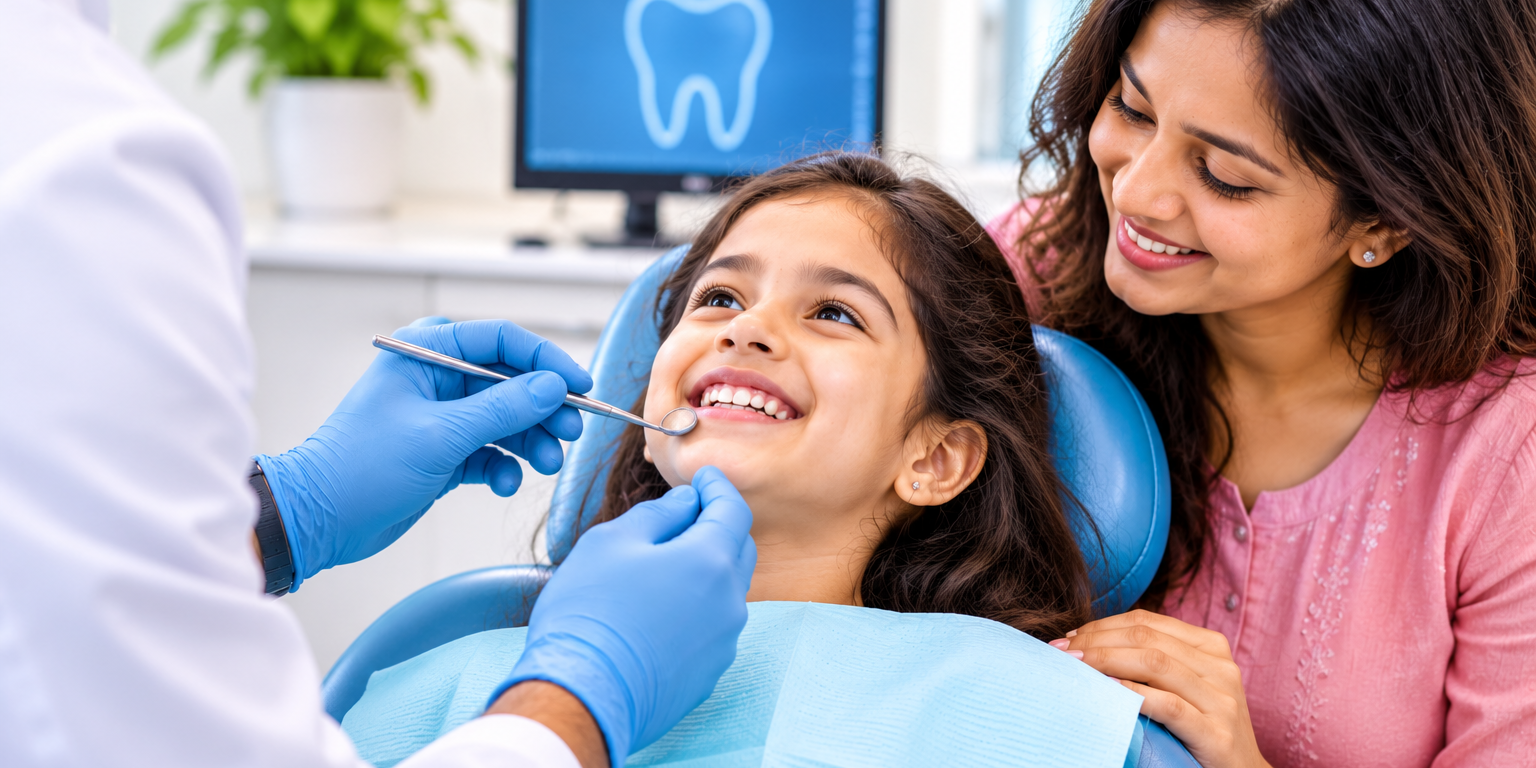
A first visit is usually relaxed and mostly about conversation and observation. In general, it involves:
- A chat with you. What you’ve noticed, what’s worrying you and any advice from your family dentist.
- A look at history. Relevant dental and medical history, including habits like thumb sucking.
- An examination. The orthodontist checks the teeth, bite and jaw.
- A review of development. Which teeth have come in, which are still to come and how things are progressing.
- Records when needed. Photographs or X-rays may be used where they are clinically useful. Not every child needs the same records.
- A recommendation. Whether the best next step is treatment, monitoring or nothing for now.
You should have time to ask questions and leave knowing what happens next. Cost is a reasonable thing to raise as well. Our guide to what influences the cost of braces in Mississauga covers how pricing works in general.
Ready to find out where your child stands? Get in touch to arrange an assessment.
What Happens If You Wait Too Long?
Nothing dramatic, in most cases. Many orthodontic concerns are perfectly fine to treat later, and not every concern needs attention right away. Plenty of children have excellent results when treatment begins in their early teens.
There are a few situations where timely evaluation matters. Some developing problems may be easier to manage while a child is still growing, and certain early options may not be available once growth has slowed. That is why an assessment is better than guessing from how the teeth look. It is not a reason to worry.
An early visit also prevents the opposite problem: spending months wondering. Whatever the result, you’ll know.
If your child already has braces or is finishing treatment, our article on why teeth shift after braces explains the importance of retainers.
How to Choose the Right Children’s Orthodontist in Mississauga
A few things are worth looking for when choosing a practice for your child:
- Specialist qualifications. An orthodontist has additional training in tooth and jaw development after dental school.
- Experience with children and teens. Ask whether they regularly treat young patients.
- Clear communication. You should understand what was found and why.
- Individualized recommendations. Advice should reflect your child, not a standard plan.
- Honest explanation of timing and alternatives. Including the option to wait.
- Practical details. Location, appointment times and a clear discussion of costs and insurance.
Tropical Orthodontics is at 265 Enfield Place, Suite 100B in Mississauga. Dr. Joel Schacher graduated in dentistry from the University of Toronto in 1977, specialized in orthodontics at the Eastman Dental Centre in Rochester, New York, and has more than 40 years of orthodontic experience. The team can assist families in English, Spanish, Portuguese, Vietnamese, Farsi and Greek. For a longer checklist, see how to choose the right orthodontist in Mississauga. You can also browse our smile gallery and treatment options.
Frequently Asked Questions
What is the best age for a child’s first orthodontic visit?
Around age seven is commonly recommended by orthodontic organizations, though older children and teenagers can be assessed at any time.
Does my child need braces at age seven?
Usually not. An assessment at seven is about checking development. Most children are monitored or treated later.
Can children wear braces while they still have baby teeth?
In selected cases, early treatment is done while some baby teeth remain. Whether it suits your child is decided after an assessment.
What are the early signs of orthodontic problems?
Crowding, gaps, protruding teeth, bite irregularities, trouble chewing and unusual timing of tooth loss are common ones. Only an orthodontist can say whether they matter.
What is Phase 1 orthodontic treatment?
It is early, targeted treatment for specific problems while baby teeth are still present. Not every child needs it.
How long does early orthodontic treatment take?
It varies by child and by problem, so it is best discussed after an examination.
Can an orthodontist assess a child before all permanent teeth appear?
Yes. That is the purpose of an early assessment, and it is often a good time to start monitoring.
Should I visit an orthodontist if my family dentist hasn’t recommended braces?
Yes, if you have concerns. Dentists and orthodontists play different roles, and you do not need a referral to ask for an assessment.
Is early orthodontic treatment always necessary?
No. Many children do well without it.
How much does children’s orthodontic treatment cost in Mississauga?
It depends on the treatment plan, so the best answer comes from an assessment. Our cost guide explains the factors involved.
Final Thoughts
You don’t have to wait for a problem to be obvious. A first orthodontic visit around age seven, or whenever something concerns you, gives you a clearer picture of your child’s development and takes the guesswork out of timing. For many families, the answer is simply “come back in a year.”
Concerned about your child’s teeth or bite alignment? Book an orthodontic assessment with Tropical Orthodontics in Mississauga to understand your child’s treatment options. You can also call us at (905) 281-8200.