Most people who start looking into braces have a similar set of questions. Which type is right for me? Will I need teeth removed? How long does treatment take? Is Invisalign better than braces? And underneath all of those questions, usually the most pressing one: where do I even start?
The answer to most of those questions is that it depends on your teeth, your bite, your age, and what treatment is actually trying to achieve for your specific situation. There is no single type of braces that suits every patient, and a good orthodontic assessment is what determines which approach makes the most sense for you.
At Tropical Orthodontics in Mississauga, Dr. Joel Schacher has been providing specialist orthodontic care for more than 40 years. This page covers the main types of braces available, what shapes the treatment decision, and what you can expect when you come in for a consultation.
What Are Braces and How Do They Work?
Braces work by applying steady, controlled pressure to the teeth over time. That pressure gradually shifts the teeth into better positions while the surrounding bone remodels to support the new placement. The process is precise and manageable, but it takes time because bone tissue needs adequate time to respond and stabilise as teeth move.
What braces address goes beyond how individual teeth look. The relationship between the upper and lower jaws, how the teeth meet when biting, and the distribution of bite forces all play a role in what orthodontic treatment is trying to achieve. A result that looks straight but leaves the bite poorly aligned is not a complete outcome, which is why treatment planning involves considerably more than lining teeth up in a row.
The Canadian Dental Association explains that orthodontic appliances move teeth by applying pressure and that well-planned treatment addresses both tooth position and bite function.
Types of Braces Available in Mississauga
There are several types of braces available, and the right choice depends on the clinical assessment rather than personal preference alone. Here is an overview of the main options offered at Tropical Orthodontics. For more detail on each, the orthodontic treatment options page covers what is available across different patient needs.
Traditional Metal Braces
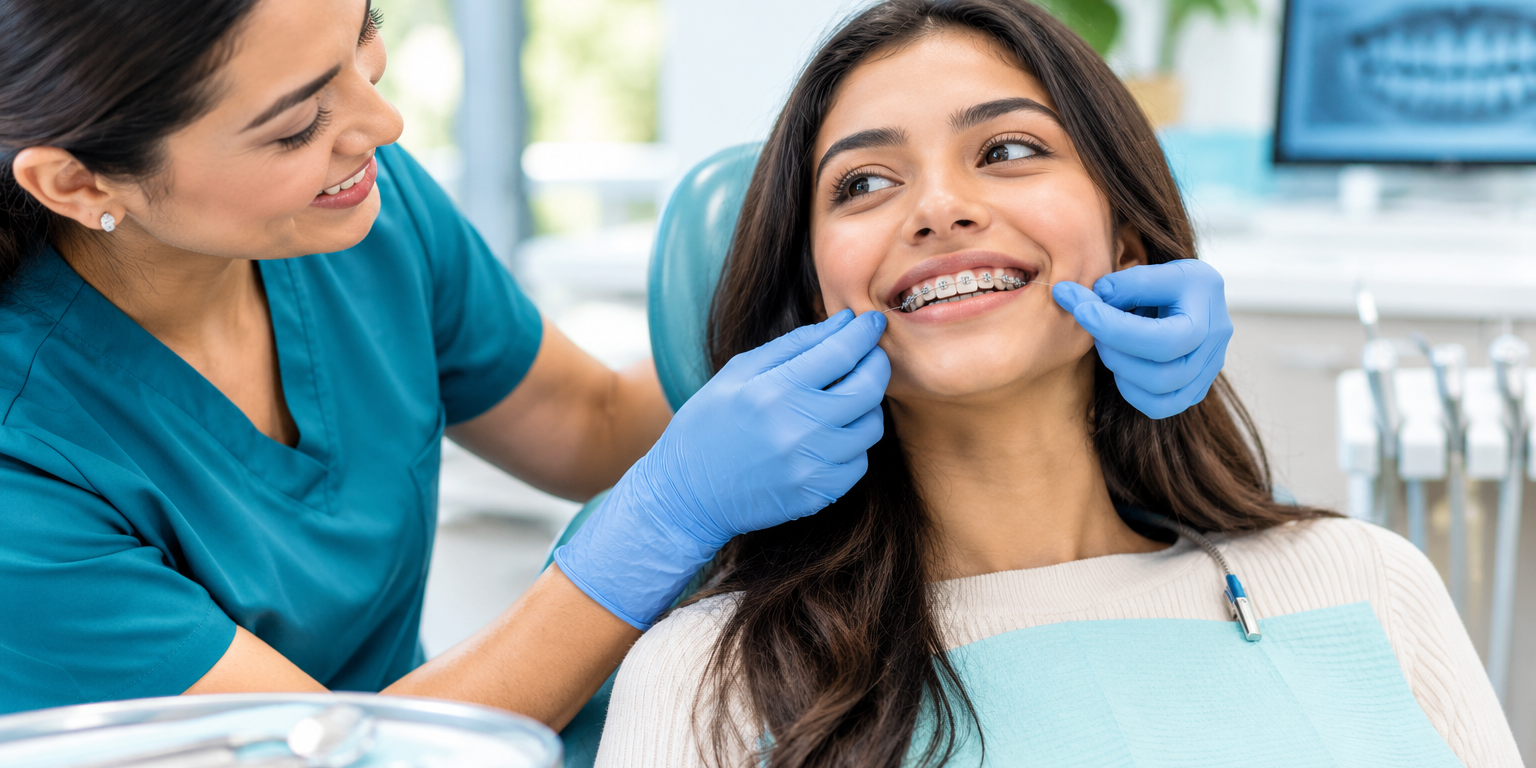
Metal braces use stainless steel brackets bonded to the teeth and connected by an archwire. They are one of the most reliable and well-established orthodontic systems available, suitable for a broad range of cases from mild crowding to more complex bite correction.
Modern metal braces are considerably more comfortable and lower profile than older designs. Because they are fixed in place throughout treatment, they work consistently regardless of patient compliance with wear time. For children, teenagers, and adults with more complex orthodontic needs, metal braces remain a strong clinical choice.
Clear Braces
Clear or tooth-coloured ceramic braces function in the same way as metal braces but use translucent brackets that blend more naturally with the teeth. For patients who want the clinical reliability of fixed braces with less visual impact, ceramic braces offer a middle ground between conventional metal brackets and removable aligners.
Ceramic brackets require a degree of extra care as they are slightly more delicate than metal, but they are a well-established option for patients who are conscious of appearance during treatment.
Pitts 21 Braces
Pitts 21 braces are a modern self-ligating bracket system that differs from conventional braces in both its mechanical design and its treatment philosophy. Beyond aligning individual teeth, Pitts 21 places particular emphasis on arch development, smile aesthetics, and how the smile relates to the face as a whole.
For patients with crowded teeth or narrower arches, this approach can be especially relevant because the system is designed to work with the natural arch form rather than simply accommodating whatever space is already there. Dr. Schacher has extensive experience with Pitts 21 and it is central to how treatment is planned at Tropical Orthodontics for many patients. Visit the dedicated Pitts 21 page for a fuller explanation of how the system works and who tends to benefit most from it.
Damon Braces
Damon braces are another self-ligating option that uses a sliding bracket mechanism rather than elastic ties to hold the archwire. The reduced friction this creates can make tooth movement more comfortable over the course of treatment and allows for a degree of efficiency in how teeth respond to the applied forces.
Damon braces are suitable across a range of orthodontic cases and are a good option for patients who want a modern fixed appliance without the bulk of older bracket designs. The dedicated Damon braces page covers the system in more detail for patients who want to understand it before their consultation.
Invisalign and Clear Aligners
Invisalign treatment uses a series of custom-made removable aligners that progressively guide teeth into better positions. Each aligner moves the teeth a small amount, and patients move through the series according to their treatment plan.
The appeal for many adults and older teenagers is that the aligners are far less visible than any fixed appliance and can be removed for eating and oral hygiene. The practical trade-off is that they need to be worn consistently for the recommended hours each day. Patients who remove them more than directed will find their treatment affected.
Invisalign suits many mild to moderate cases well, and the system has improved significantly in its ability to handle more complex tooth movements over recent years. Whether it is appropriate for a specific patient depends on the clinical assessment, not on personal preference or what has worked for someone else.
Which Type of Braces Is Right for You?
There is no universally correct answer to this question, and any recommendation made without examining your teeth and bite is not worth much.
The factors that shape the treatment recommendation include the nature and severity of the orthodontic concern, the bite relationship between the upper and lower jaws, the patient’s age and whether jaw growth is still occurring, lifestyle and the ability to follow treatment guidelines, appearance preferences, and what the patient is ultimately hoping to achieve.
Two patients who look like similar cases from the outside can require quite different treatment approaches once a proper assessment reveals the full picture. This is why the appliance decision should follow the diagnosis rather than precede it.
Braces for Children in Mississauga
The Canadian Association of Orthodontists recommends that children have an initial orthodontic assessment by around age seven. This does not mean treatment starts at seven. It means an orthodontist can identify developing concerns at a stage where intervention, if needed, is more straightforward than it would be once growth is complete.
For some children, early treatment addresses a specific developing problem. For others, the right course of action is to monitor development over time and begin treatment when the clinical conditions are most favourable. Parents who notice crowded teeth, difficulty biting or chewing, prolonged thumb sucking, or teeth that appear noticeably out of position are welcome to bring their child in for an assessment.
Not every child will need braces, and an honest assessment will tell you clearly whether treatment is indicated or whether watching and waiting makes more sense.
Can Adults Get Braces?
Yes, and adult orthodontic treatment is considerably more common than it was a decade ago. Teeth can be moved at any age provided the gums and supporting bone are healthy, and the treatment options available today make the experience far more manageable for adult life than most patients expect.
Many adults come in after noticing teeth shifting since previous treatment, after years of gradual crowding, or simply after deciding they are ready to address something that has been bothering them for a long time. Others are dealing with bite changes or jaw discomfort that has developed over time.
Adult cases sometimes involve additional considerations including existing dental restorations, gum health, and the degree of shifting that has occurred. These factors are assessed as part of the treatment planning process. They add complexity in some cases, but they are rarely barriers to treatment.
How Long Does Braces Treatment Take?
Treatment duration varies considerably from one patient to the next, and an estimate given without a clinical assessment is not particularly meaningful.
The complexity of the tooth and bite movement required, the type of appliance used, the patient’s age, and how consistently treatment guidelines are followed all influence how long treatment takes. Some cases are straightforward and resolve within a year. Others involving more significant bite correction or crowding take longer.
Dr. Schacher will give you a realistic, individualised estimate during your consultation based on your specific teeth and bite rather than a general figure that applies to the average patient.
Do Braces Always Require Tooth Extractions?
No. Whether extractions are needed depends entirely on the individual patient’s clinical situation. The degree of crowding, the bite relationship, the available arch space, and what long term stability requires all factor into the decision.
Modern orthodontic techniques have made non-extraction treatment achievable in a wider range of cases than was previously possible. Arch development approaches, particularly those used with systems like Pitts 21, can create space in ways that older orthodontic methods could not reliably achieve. That said, extractions remain the right clinical call in certain situations, and the decision should always be based on a thorough individual assessment rather than a predetermined preference in either direction.
What Happens During an Orthodontic Consultation?
A first consultation at Tropical Orthodontics is complimentary and involves no obligation. Dr. Schacher will examine your teeth and bite clinically and will typically take photographs and digital records where appropriate to get a complete picture of your orthodontic situation.
From there, he will explain what he has found, discuss the treatment options that are appropriate for your specific case, and outline what a personalised treatment plan would involve. You will have the opportunity to ask questions about treatment, timing, and cost, and you will leave the appointment with a clear understanding of your options without any pressure to commit to anything on the day.
How Much Do Braces Cost in Mississauga?
The cost of orthodontic treatment depends on the complexity of the case, the type of treatment recommended, and the overall treatment duration. There is no meaningful flat fee that applies to every patient, because no two treatment plans are the same.
Factors that influence the overall cost include the nature of the orthodontic concern, whether bite correction is involved alongside alignment, the type of appliance used, and the length of the treatment plan. Payment plan options are available, and patients with employer dental benefit plans should review their policy before their consultation to understand what orthodontic coverage, if any, they have.
The best way to get an accurate sense of what treatment would cost for your specific situation is to come in for a consultation, where everything can be discussed openly and honestly.
Choosing an Orthodontist in Mississauga
Orthodontic treatment is a significant investment of time and money, and choosing the right provider matters more than many patients initially consider.
A certified orthodontist completes two to three years of specialist training after dental school, focused specifically on tooth movement, bite correction, and jaw relationships. That additional training makes a meaningful difference in the quality of diagnosis and treatment planning, particularly for cases involving more than mild crowding.
Beyond qualifications, it is worth considering the range of treatment options available, how clearly the orthodontist explains their findings and recommendations, and whether the consultation feels genuinely tailored to your situation. Experience across a wide range of cases over many years develops clinical judgement that informs treatment decisions in ways that are difficult to quantify but easy to see in long term outcomes.
Dr. Schacher has been providing orthodontic care in Mississauga for more than 40 years. Tropical Orthodontics has received the Consumer Choice Award for Business Excellence for ten consecutive years from 2017 through 2026. Our team speaks English, Spanish, Portuguese, Vietnamese, Farsi and Greek.
Frequently Asked Questions About Braces
Are clear braces the same as clear aligners?
No. Clear braces refer to ceramic brackets that are bonded to the teeth like conventional braces but are made from a tooth-coloured material. Clear aligners like Invisalign are removable trays that fit over the teeth without any brackets or wires. Both reduce the visual impact of orthodontic treatment compared to metal braces, but they work differently and suit different clinical situations.
Can crowded teeth be treated without extractions?
In many cases, yes. Modern orthodontic techniques including arch development approaches can create space without removing healthy teeth. Whether a non-extraction approach is appropriate depends on the individual case. A proper assessment will determine what is clinically suitable for your specific situation.
Do braces hurt?
Most patients experience some pressure and mild soreness for a day or two after each adjustment appointment or when starting a new set of aligners. This settles fairly quickly. Modern systems are considerably more comfortable than older designs, and most patients adjust to their appliance within a short time.
Can I choose which type of braces I get?
Patient preference is a factor in the treatment discussion, but the clinical assessment drives the recommendation. Some cases are suitable for several different appliance options, giving patients genuine choice. Others have characteristics that make one approach more appropriate than another. Dr. Schacher will explain the options that are clinically suitable for your specific situation and why.
What happens after braces are removed?
Once active treatment is complete, patients are given retainers to wear according to their orthodontist’s instructions. Retainers are what maintain the result once the braces come off. Teeth have a natural tendency to drift back toward their original positions without retention, which is why wearing retainers as directed is an important part of the overall treatment outcome.
Do adults need different braces than teenagers?
The appliances used are generally the same, but adult treatment planning often involves additional considerations including existing dental work, gum health, and the nature of any shifting that has occurred over time. These factors are assessed as part of the treatment planning process and shape the recommendation accordingly.
How do I get started?
The most straightforward next step is to book a complimentary consultation. You can contact our team online or call us directly at (905) 281-8200. Dr. Schacher will assess your teeth and bite, explain your options, and give you a clear picture of what treatment would involve for your specific situation.