One of the most common concerns patients bring to an orthodontic consultation is whether straightening their teeth will mean losing some of them first. It is a reasonable concern, and it deserves a thorough, honest answer rather than a reassuring generalization.
The short answer is that tooth extractions are sometimes necessary and sometimes not. The decision depends on a detailed assessment of each patient’s individual anatomy, bite, facial profile, gum health, and treatment objectives. There is no universal rule that applies to every crowded smile, and any recommendation made without a proper clinical evaluation is not particularly useful.
This article explains how orthodontists think through the extraction decision, what non-extraction alternatives exist and when they are appropriate, and what patients should ask before committing to any treatment plan.
Why Do Orthodontists Recommend Tooth Extractions?
Extractions are recommended when there is not enough space within the dental arch to achieve a stable, well-aligned result through other means. The calculation behind that decision involves considerably more than measuring the gap between teeth.
The main clinical circumstances in which extractions may be considered include:
- Significant dental crowding. The degree of crowding is measured in millimetres of discrepancy between available arch length and the total width of the teeth. Mild discrepancies of a few millimetres can often be managed without extractions. Larger discrepancies require more careful evaluation of alternatives.
- Protrusive incisors or arches. When the front teeth sit considerably further forward than ideal, retracting them requires space. Extractions, typically of premolars, create the room needed to move the front teeth back into a more balanced position. Attempting retraction without adequate space tends to tip teeth rather than move them bodily, producing an unstable result.
- Bite relationships requiring space management. Certain bite patterns, particularly significant overbites or cases where the upper and lower jaws are noticeably misaligned, may require tooth movement that only becomes feasible with extraction spaces.
- Biological limits on tooth movement. Teeth can only be moved safely within the boundaries of the supporting bone and gum tissue. Moving teeth beyond those boundaries increases the risk of bone loss, gum recession, and long-term instability. Where the arch is already near its natural limit, creating space by other means may not be safe.
- Individual facial and anatomical considerations. The relationship between tooth position, lip support, and facial profile plays a role in every treatment decision. Extracting teeth when the lips are already well supported can flatten the facial profile in ways that are difficult to reverse.
What Does an Orthodontist Assess Before Deciding?
The extraction decision is not made on the basis of a single measurement or a visual impression of how crowded the teeth look. It follows a structured clinical assessment that considers multiple factors together.
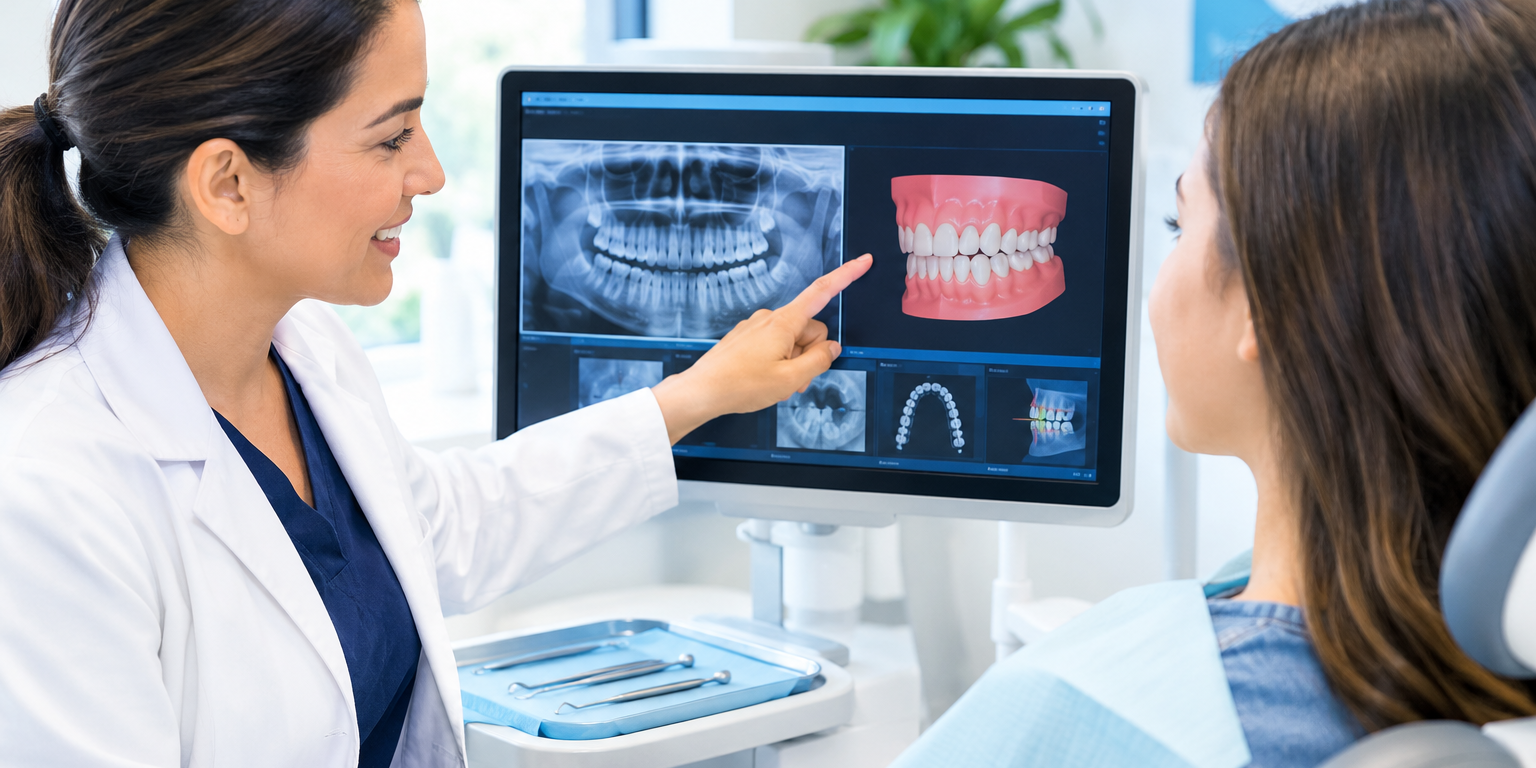
A thorough pre-treatment evaluation typically includes:
- Clinical examination of the teeth and bite
- Dental photographs taken from standardized angles
- Digital scans or study models of the teeth
- Radiographs where clinically indicated, including lateral cephalometric and panoramic x-rays
- Assessment of incisor inclination and jaw relationships
- Evaluation of gum tissue health and bone support
- Review of the patient’s goals, age, and dental history
The table below summarizes the key clinical factors and why each matters:
| Clinical Factor | Why It Matters |
| Degree of crowding | Determines how much space needs to be created |
| Incisor inclination | Affects how much retraction or advancement is needed |
| Facial profile and lip position | Guides decisions about tooth movement direction |
| Skeletal jaw relationship | Influences whether bite correction needs extraction support |
| Bone and gum health | Sets the biological limits of safe tooth movement |
| Patient age | Affects whether growth can be used as part of treatment |
| Patient goals | Shapes priorities between function, aesthetics, and timing |
Importantly, treatment planning is based on the complete clinical picture rather than the type of braces being considered. The appliance follows the diagnosis, not the other way around.
The Canadian Association of Orthodontists notes that specialist orthodontic assessment involves comprehensive clinical records and that treatment planning should be individualised to each patient’s specific needs and anatomy.
How Can Orthodontists Create Space Without Extractions?
Where the clinical picture allows, several approaches can create space within the existing arch rather than through extraction. Each has a defined range of application and meaningful limitations.
Interproximal Reduction
Interproximal reduction, sometimes called enamel reduction, involves carefully removing small amounts of enamel from the sides of selected teeth to create space.
Key points to understand:
- The amount of enamel that can be safely removed is limited, typically no more than half a millimetre per tooth surface
- It is most useful for mild to moderate crowding where only a small amount of additional space is needed
- It is not appropriate as a primary strategy for significant crowding
- It is not a substitute for extractions when several millimetres of space are required
- When used in the right case, it is a well-established technique with a good clinical track record
Arch Development and Tooth Repositioning
Arch development refers to guiding the dental arch to a slightly wider or longer form, creating additional space for crowded teeth. This is one of the most commonly discussed approaches in non-extraction orthodontics and can produce genuinely good results in appropriately selected cases.
The critical point is that arch development has biological limits:
- Teeth can be moved within the supporting bone, but expanding beyond those limits causes the overlying bone and gum tissue to thin
- Excessive expansion risks gum recession, bone loss, and long-term instability
- The amount of safe arch development varies considerably between patients depending on their skeletal anatomy and existing tooth positions
- Broader, fuller smiles are often achievable, but within limits that must be respected for long-term stability
Other Space-Management Approaches
In growing patients, functional appliances or early intervention strategies can sometimes influence jaw development in ways that improve arch space before fixed braces begin. These approaches are most relevant for children and younger teenagers and are generally not applicable in adult patients whose growth is complete.
The important point across all of these approaches is that non-extraction treatment is not automatically preferable, faster, or safer for every patient. Where there is insufficient space and biological limits have been reached; attempting to avoid extractions can compromise the quality and stability of the result.
Our detailed guide on non-extraction orthodontics in Mississauga covers these approaches in more depth for patients who want to understand the full picture before their consultation.
What Role Can Pitts21 Braces Play?
Pitts21 is an orthodontic bracket system developed with particular attention to arch form, smile aesthetics, and the three-dimensional control of tooth movement. Like all fixed orthodontic appliances, it works by using brackets bonded to the teeth and connected by archwires to apply controlled forces that move teeth gradually over time.
What Pitts21 involves:
- A self-ligating bracket design that holds the archwire within the bracket itself
- A treatment philosophy that actively prioritizes developing the natural arch form and smile width
- Emphasis on smile arc development and facial balance alongside tooth alignment
- Effective support for non-extraction approaches in clinically appropriate cases
What Pitts21 does not do:
- Determine whether extractions are necessary. That decision comes from the clinical assessment
- Guarantee a specific treatment time or outcome
- Eliminate the need for extractions in cases where they are genuinely indicated
A patient with significant crowding, protrusion, or a bite pattern requiring extraction-based mechanics will not avoid extractions simply by using Pitts21 braces. Equally, a patient who is a good candidate for non-extraction treatment can achieve excellent results with a well-designed treatment plan regardless of which bracket system is used.
Dr. Schacher has extensive experience with Pitts21 and uses it as a central part of treatment planning at Tropical Orthodontics. More detail on the system is available on the Pitts21 braces page. For patients specifically asking about severe crowding, our article on whether Pitts21 braces can treat severe crowding addresses that question directly.
When May Tooth Extractions Still Be the Right Choice?
Extractions are the right clinical decision in certain situations, and a well-reasoned extraction treatment plan produces excellent long-term results. The following circumstances are among those where extractions may be appropriate:
| Clinical Situation | Why Extractions May Be Appropriate |
| Severe crowding | Discrepancy too large to address safely through arch development alone |
| Significant incisor protrusion | Retraction requires space that cannot be created otherwise |
| Complex bite correction | Jaw discrepancy mechanics may require extraction spaces |
| Reduced bone support | Limiting tooth movement reduces risk of further bone loss |
| Skeletal pattern limitations | Certain jaw relationships make non-extraction outcomes unstable |
The framing of extractions versus non-extraction treatment as two competing ideologies is not clinically useful. The appropriate decision is patient-specific, and the goal in either case is the same: a stable, well-aligned result that supports good oral health and long-term function.
Our article on whether overcrowded teeth can be fixed without removing teeth covers the specific question of crowding severity and what determines when extraction becomes necessary.
Does Avoiding Extractions Always Mean Better Results?
Not necessarily, and this is an important point that is sometimes misrepresented in orthodontic marketing.
Avoiding extractions when the clinical situation genuinely calls for them can result in:
- Teeth being moved to the outer edges of their bony support, thinning the overlying bone and gum tissue
- Gum recession that can be difficult or impossible to reverse
- Tooth positions that are not stable, leading to faster relapse after treatment
- Compromises in bite alignment that affect long-term function
On the broader question of facial profile changes, the evidence is worth understanding clearly:
- Well-planned extraction treatment does not cause the degree of facial flattening sometimes described in patient-facing marketing materials
- The effect on facial profile depends far more on how much tooth movement is performed and in which direction than on whether extractions were used
- In cases with protrusive front teeth, extractions and incisor retraction can actually improve the facial profile
- Claims linking orthodontic extractions to airway or temporomandibular joint problems are not supported by consistent, high-quality evidence
A well-planned extraction case produces a stable result with a good facial profile. A poorly planned non-extraction case, where teeth have been moved beyond their biological limits, does not produce a superior result simply by virtue of having preserved all the teeth.
The goal of treatment planning is not to avoid extractions or to prefer them. It is to find the approach that best serves each individual patient’s clinical needs, long-term stability, and overall oral health. More information on teeth alignment approaches in Mississauga is available in our guide to teeth alignment without surgery.
Questions to Ask Your Orthodontist Before Starting Treatment
Before committing to any orthodontic treatment plan, patients are well served by asking the following questions and expecting clear, specific answers:
- Why are extractions being recommended or not recommended in my case? A good answer will reference specific clinical findings from your records, not just a general preference for one approach.
- How much crowding do I have, and how was that measured? Understanding the degree of discrepancy in millimetres gives context to the treatment recommendation.
- What are the alternatives to the proposed plan, and what are their limitations? A thorough orthodontist will explain what non-extraction treatment could achieve in your case and where it reaches its limits.
- How will the proposed treatment affect my bite, tooth positions, and facial profile? The answer should be specific to your clinical situation, not a generalization.
- What are the relevant risks and potential compromises in the proposed plan? Every treatment plan involves trade-offs, and a transparent discussion of these is a sign of a clinician focused on your long-term interests.
- How will progress and stability be monitored during and after treatment? Understanding the retention plan after active treatment ends is just as important as understanding the treatment itself.
- What clinical records and diagnostic findings support the recommendation? Patients have every right to understand what information the treatment plan is based on.
Considering Braces in Mississauga?
If you have been told you may need extractions before braces, or if you are simply exploring your orthodontic options, a proper clinical assessment is the only reliable way to understand what your specific situation requires.
At Tropical Orthodontics in Mississauga, Dr. Joel Schacher offers orthodontic consultations based on a thorough assessment of each patient’s teeth, bite, facial profile, and individual treatment goals. Treatment planning at our practice is built around what is appropriate for the individual patient rather than a fixed preference for or against extractions.
You can reach our team at (905) 281-8200 or visit tropicalorthodontics.com to book a consultation.
Frequently Asked Questions
Do all patients with crowded teeth need tooth extractions before getting braces?
No. Whether extractions are needed depends on the degree of crowding, the bite relationship, the facial profile, and the biological limits of the individual’s supporting bone and gum tissue. Many patients with mild to moderate crowding can be treated without extractions. A proper clinical assessment is the only reliable way to determine which applies to your situation.
What is the difference between extraction and non-extraction orthodontic treatment?
Extraction-based treatment involves removing one or more teeth, typically premolars, to create space for tooth movement. Non-extraction treatment uses approaches such as arch development, interproximal reduction, or tooth repositioning to create space within the existing arch. Neither approach is universally superior. The appropriate choice depends on the individual patient’s anatomy, bite, and treatment objectives.
Can Pitts21 braces avoid extractions?
Pitts21 braces can support non-extraction treatment effectively in appropriate cases. However, the bracket system does not determine whether extractions are necessary. That decision is based on the clinical assessment. In cases where extractions are genuinely indicated, Pitts21 braces are used as part of an extraction-based treatment plan.
Will removing teeth for braces change my face shape?
Well-planned extraction treatment does not cause significant facial flattening in most patients. The effect on facial profile depends primarily on how much tooth movement is performed and in which direction. In cases with protrusive front teeth, extractions and incisor retraction can improve the facial profile. Claims that extractions routinely flatten or age the face are not consistently supported by clinical evidence.
How do I know if I need extractions before starting braces?
You will only know after a thorough clinical assessment that includes examination of your teeth and bite, dental photographs, and radiographs where indicated. An orthodontist can then measure the degree of crowding, assess your bite, evaluate your facial profile, and recommend the most appropriate treatment approach for your specific situation.